
What is the Cambridge Upskill English Test?
Short answer: Cambridge Upskill is a digital English test by Cambridge University Press & Assessment that measures Speaking, Listening, Reading and Writing and reports a CEFR level from A1 to B1 for each skill. In Nepal it is used mainly by Nepal–Israel G-to-G caregiver applicants.
Cambridge Upskill is an English language test developed by Cambridge University Press & Assessment. It assesses four skills (Speaking, Listening, Reading and Writing) and reports your level on the Common European Framework of Reference (CEFR). It is also called the Upskill test, the Cambridge Upskill exam or UpSkill from Cambridge. It is a different test from IELTS and from Cambridge Linguaskill.
The test covers three levels. Within this test, A1 is the lowest and B1 is the highest:
Upskill is used to assess English for employment and other purposes. In Nepal, candidates take it to meet the English requirement for the Nepal–Israel Government-to-Government (G-to-G) caregiver recruitment programme.
Cambridge describes Upskill as a flexible test taken through the Upskill app or online. In Nepal, candidates sit it at the CIIN test centre, where the equipment is provided; our students have taken it on computers there. Follow the instructions in your booking confirmation.
Cambridge Upskill test format and timing
Short answer: The test has 4 sections and 17 parts and takes about 92 minutes: Speaking about 12 minutes (5 parts), Listening 25 minutes (5 parts), Reading 25 minutes (5 parts, 20 questions) and Writing 30 minutes (2 parts, at least 50 words each).
The test has four sections. Your total testing time is about 92 minutes (1 hour 32 minutes). Cambridge quotes about 1 hour 35 minutes for one sitting, which includes moving between sections; the section times themselves add up to 92 minutes.
| Section | Parts | Time | What you do |
|---|---|---|---|
| Speaking | 5 | About 12 minutes | Answer short questions, read sentences aloud and leave a voicemail. Your recordings are marked by software. |
| Listening | 5 | 25 minutes | Listen to chats, meetings and messages. Each recording plays only twice. |
| Reading | 5 | 25 minutes | Answer 20 questions on notices, messages, sentences and a longer text. |
| Writing | 2 | 30 minutes | Type two short texts of at least 50 words each. |
| Total | 17 | About 92 minutes | |
Which section comes first?
There is no single fixed order. The centre may give students different section orders based on the seating plan, so not everyone does Speaking at the same time. For example, one student may go Speaking → Reading → Writing → Listening, and another Reading → Writing → Listening → Speaking. Follow the order on your screen.
Speaking section: 5 parts
Short answer: Speaking takes about 12 minutes and has 5 parts: short answers (10 seconds), longer answers (20 seconds), two read-aloud parts (10 seconds per sentence) and a one-minute voicemail. You can re-record in Parts 1–4 but not in Part 5.
You use the headphones and microphone provided at the venue. When the test asks for microphone permission, select Allow. The system records your answers and marks them automatically.
| Part | Task | Questions | Time to speak |
|---|---|---|---|
| Part 1 | Listen and answer | 4 questions | 10 seconds each |
| Part 2 | Listen and answer (longer) | 4 questions | 20 seconds each |
| Part 3 | Read aloud | 4 sentences | 10 seconds per sentence |
| Part 4 | Read aloud (extended) | 4 sentences | 10 seconds per sentence |
| Part 5 | Leave a voicemail | 1 situation | 40 seconds to prepare, then about 70 seconds to record (aim for a full minute) |
- In Parts 1–4 you can listen to your recording and try again if you are not happy with it. In Part 5 you cannot retry.
- In Part 5, aim to speak for about 60 seconds; the recording stops automatically at about 70 seconds.
- If you finish early you can submit; when time is up, your answer is submitted automatically.
Sample Part 2 question and B1 answer
“What do you usually do on weekends?” (about 20 seconds)
A2-style: “I stay at home.”
B1-style: “On weekends I usually help my mother at home and then meet my friends. I like it because I'm busy during the week. For example, last Saturday we cooked momo together. So weekends are my time to relax.”
Why it is B1: it answers, gives a reason, adds a real example in the past tense and finishes clearly.
Sample Part 5 voicemail (about 60 seconds)
Task: you can't meet a colleague tomorrow. Explain why, suggest another day and apologise.
“Hello Mr Sharma, this is Gita. I'm calling about our meeting tomorrow at ten. I'm really sorry, but I can't come because I have to take my mother to the hospital. Could we meet on Thursday instead? I'm free all morning, so any time before twelve is fine. I'm sorry for the change. Please let me know if Thursday works for you. Thank you, and have a good day.”
Structure: greeting and name → reason for calling → every task point → extra detail → polite closing.
Practise Part 5: voicemail timer
Press start: 40 seconds to plan, then about 70 seconds to speak. Keep talking until at least 60 seconds.
Listening section: 5 parts
Short answer: Listening takes 25 minutes and has 5 parts with everyday conversations, meetings, voicemails and announcements. Each recording plays only twice, and one part asks you to type a missing word.
You hear short recordings such as conversations, meetings, voicemails and announcements. Each recording plays only twice. Read the question before you press Listen, use the first play to find your answer, and the second to check details like numbers, names and days.
Reading section: 5 parts
Short answer: Reading takes 25 minutes: 20 questions in 5 parts (four per part), about five minutes per part. Texts are short notices, messages, sentences, a form and one longer text.
There are four questions in each part, which gives you about five minutes per part, or roughly 75 seconds per question. Reading is mainly about understanding meaning; only a few questions test grammar directly.
| Part | Task | What it checks |
|---|---|---|
| Part 1 | Read 4 short texts and choose the answer (3 options) | Understanding notices, messages and offers |
| Part 2 | Choose the missing word in 4 sentences (3 options) | Grammar and meaning together |
| Part 3 | Type the missing word in each sentence | Grammar, vocabulary and spelling |
| Part 4 | Read a message and complete a form | Finding and transferring details |
| Part 5 | A longer text with 4 linked paragraphs and 4 questions | Understanding the whole text |
Sample Reading question
Notice: “Swimming pool closed for cleaning on the first Monday of every month. Opens at 2 pm on those days.” When can you NOT swim in the morning?
A. Every Monday · B. The first Monday of each month ✓ · C. Every day before 2 pm
“Every Monday” and “before 2 pm” are traps built from words in the notice.
Writing section: 2 parts
Short answer: Writing takes 30 minutes for 2 typed answers of at least 50 words each: a personal email (Part 1) and a more formal reply such as a job application (Part 2). Answer every point in the task.
You type both answers on the computer. Each answer needs at least 50 words, and in practice it helps to give each one about 15 minutes.
Before writing, answer three questions: Who am I writing to? Why am I writing? What information must I include? Then answer every required point in the question. Leaving one out is a common way to lose marks.
Sample Part 1 email (58 words)
Task: ask a colleague to change shifts with you. Explain why and offer something in return.
“Hi Ramila, I hope your week is going well. I'm writing to ask a favour. Could you work my shift on Tuesday morning? I have an important English exam that day. If you agree, I can work your Friday evening shift instead. Please let me know by tomorrow. Thank you very much. Best regards, Kiran”
It covers both task points (why + offer), uses a friendly tone and passes 50 words.
Levels needed for the Israel caregiver (G-to-G) programme
Short answer: Nepal–Israel G-to-G caregiver applicants prepare for Speaking B1, Reading A2, Listening A2 and Writing A1 in the Cambridge Upskill test. Each skill is checked on its own, so a higher level in one skill does not make up for a lower one. Confirm in the latest Department of Foreign Employment notice.
For the Nepal–Israel G-to-G caregiver application, the requirements students prepare for are:
| Skill | Level | In practice |
|---|---|---|
| Speaking | B1 | Developed answers with reasons and examples; a clear one-minute voicemail |
| Reading | A2 | Short notices, messages and simple texts |
| Listening | A2 | Short, clear conversations; times, places and numbers |
| Writing | A1 | Short, simple messages with basic information |
That is why Speaking B1 is the main focus for most candidates. In our experience, Writing is the section students find easiest.
Check your levels
Choose your level in each skill (from a result or a practice test) to see whether it meets the levels above.
Where the G-to-G programme is announced
The Nepal–Israel G-to-G caregiver programme is run by Nepal's Department of Foreign Employment. Notices are published on dofe.gov.np, and applications are made through the FERMS portal. Notices also set age, education and health conditions, which are separate from the English test.
Cambridge Upskill test fee and how to book in Nepal
Short answer: The Cambridge Upskill test fee in Nepal is NPR 5,000 (CIIN, checked 14 Nov 2026). You book online at whitelotusnepal.com/register with your passport, phone number and email, then receive the date, venue and reporting time by email. Preparation course fees are separate from the exam fee.
The exam fee is NPR 5,000. Bookings are made online through the booking site linked from CIIN's Upskill page (White Lotus Nepal).
Keep these ready before booking
- Your phone number
- A valid passport
- An email address you can access, such as Gmail
- NPR 5,000 for the exam fee
How to book your test
- Open the booking pageGo to whitelotusnepal.com/register and check whether registration is open.
- Choose a dateSelect an available test date.
- Enter your details and payFill in your details and complete the booking and payment.
- Check your emailYour booking confirmation, venue, test date and reporting time are sent to the email you used.
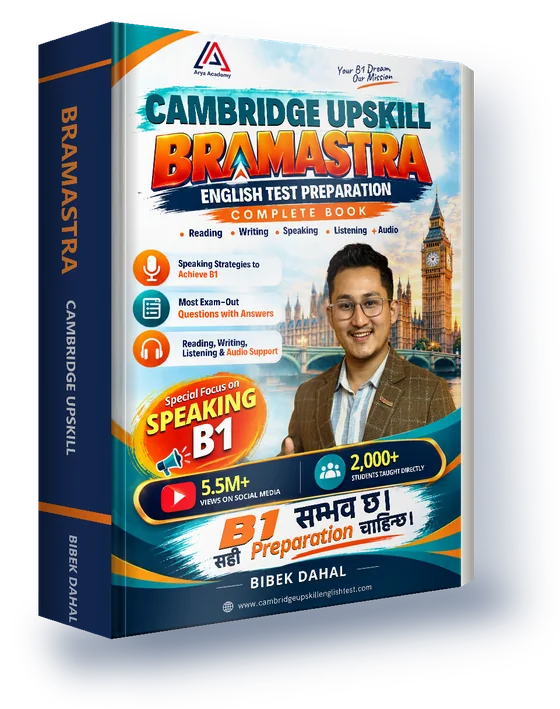
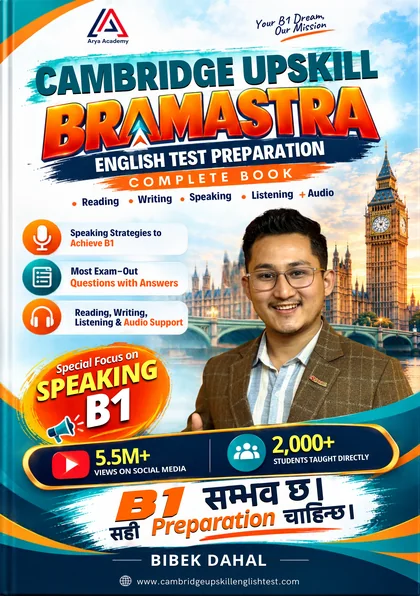
Bramastra: the Cambridge Upskill English Test book
655 pages covering all four sections, with a special focus on Speaking B1: 130 voicemail model answers, a 48-question Part 2 bank, 20 Reading sets and Nepali explanations.
Exam day: venue, what to bring and rules
Short answer: Go to CIIN, 4th Floor, United World Trade Centre, Tripureshwor, Kathmandu, at least one hour before your reporting time, with your original passport and booking confirmation. Pens, paper and notes are not allowed; the equipment is provided.
Where is the test taken?
Most tests take place at CIIN International Qualifications, 4th Floor, United World Trade Centre (UWTC), Tripureshwor, Kathmandu. Some sessions may be held at a different venue, so check your confirmation email before you travel.
What to take with you
- Your original, valid passport
- Your booking confirmation, printed or saved as a PDF on your phone
Rules to know
- CIIN states the test can be taken in one sitting of about 92 minutes, or in parts over five days, and sections can be done in any order. Ask CIIN which option your booking uses.
- Pens, paper and notes are not allowed in the test room. The equipment you need is provided.
- Arrive at least one hour early. Arriving late can mean missing your exam, and you may need to book again.
- Some automated booking emails still ask for headphones and a phone charged to at least 80%. If yours does, confirm the latest equipment rules with CIIN.
Cambridge Upskill results: when, how to check, and validity
Short answer: Results usually arrive within 24–48 hours by email, and some take a few days longer. Check them at whitelotusnepal.com/check-result with your registration code, passport number and date of birth. The report shows an overall CEFR level and a level for each skill.
The centre's guidance is that results are usually available within 24–48 hours; Cambridge says a report can be ready in as little as 30 minutes, but that is a best case. Some results take a few days longer. They are sent to your registered email, so check your Inbox and Spam folder. There is no pass or fail mark: the report gives a CEFR level for each skill, an overall level and “Can do” statements.
How to check your result online
- Keep your details readyRegistration code, passport number and date of birth.
- Open the result pageVisit whitelotusnepal.com/check-result.
- Enter your detailsComplete the security check and click "Check Result".
How long is the result valid?
The published Upskill terms reviewed for this guide do not specify a fixed validity period. If you plan with two years, treat that as an estimate only. Before using your result for a G-to-G application, check the latest official notice or ask the relevant authority how recent your result must be.
Changing your date, retakes and CIIN contact
Short answer: To change a date, email CIIN early with your booking details and a documented reason; approval depends on CIIN. To retake, make a new booking and pay the fee again. CIIN: 01-4117104 / 01-4117105, mail@ciin.org.np.
If a genuine problem stops you from attending, email CIIN as early as possible and include your full name and booking reference, your scheduled test date, the reason, and documents that support it. A new date depends on CIIN's approval and its current rules, so ask about the notice period and get written confirmation of any change.
What if you don't get the level you need?
You can take the test again by making a new booking and paying the fee again. Before you rebook, focus on the skill that fell short (usually Speaking) instead of repeating everything.
Contact CIIN (the test centre)
- Phone: 01-4117104 / 01-4117105
- Mobile: 9708085842 / 9708085843 (call hours 11 AM–3 PM)
- Email: mail@ciin.org.np
- Address: 4th Floor, United World Trade Centre, Tripureshwor, Kathmandu
How to prepare for Cambridge Upskill B1
Short answer: Learn the format first, then one answer structure per Speaking task (answer, reason, example, finish for Part 2; a five-step voicemail for Part 5). Practise Reading and Listening in timed sets, write with a template, and take full timed mock tests on a computer.
Most students who miss B1 don't lack vocabulary. They lack a structure to follow when the timer starts. Prepare in this order:
- Understand the format firstKnow every part, its timing and its rules (this page), so nothing surprises you on the day.
- Learn one format per Speaking taskA developed answer for Part 2 and a fixed voicemail structure for Part 5. Then practise building your own answers instead of memorising.
- Practise Reading and Listening in timed setsFive minutes per Reading part, two plays per recording. Check every wrong answer against the text or script.
- Write with a template and type itAnswer every point in 50+ words, typed on a computer.
- Rehearse on a computerTake full mock tests with a timer, and review your weak parts before the real exam.
Cambridge Upskill English Test: frequently asked questions
What is the Cambridge Upskill English Test?
It is a digital English test developed by Cambridge University Press & Assessment. It tests Speaking, Listening, Reading and Writing and reports a CEFR level from A1 to B1 for each skill. In Nepal it is taken at CIIN International Qualifications in Kathmandu.
How long is the Cambridge Upskill test?
About 92 minutes in total: Speaking about 12 minutes, Listening 25 minutes, Reading 25 minutes and Writing 30 minutes.
What is the Cambridge Upskill test fee in Nepal?
The exam fee is NPR 5,000. Fees can change, so confirm the current amount on the official booking page before you pay.
Where is the Cambridge Upskill test taken in Nepal?
Most tests take place at CIIN International Qualifications, 4th Floor, United World Trade Centre (UWTC), Tripureshwor, Kathmandu. Some sessions may be held elsewhere, so check your confirmation email.
How do I book the Cambridge Upskill test?
Book online at whitelotusnepal.com/register. Keep your phone number, a valid passport, an email address and NPR 5,000 ready. Your confirmation and test details are sent by email.
What level is needed for the Israel caregiver (G-to-G) programme?
Students prepare for Speaking B1, Reading A2, Listening A2 and Writing A1. Requirements can change, so always check the latest official recruitment notice.
When do Cambridge Upskill results come, and how do I check them?
Results usually arrive within 24 to 48 hours by email, and some take a few days longer. Check them at whitelotusnepal.com/check-result with your registration code, passport number and date of birth, and watch your inbox and spam folder.
How long is the Cambridge Upskill result valid?
The published Upskill terms do not specify a fixed validity period. Check the latest official notice or ask the relevant authority how recent your result must be for your application.
Is the Cambridge Upskill test on mobile or on a computer?
Cambridge offers Upskill through an app and online. In Nepal, candidates sit it at the CIIN test centre, where the equipment (headphones and microphone) is provided; our students have taken it on computers there. Follow the instructions in your booking confirmation.
Can I redo a Speaking answer in the Upskill test?
In Speaking Parts 1 to 4 you can listen to your recording and try again. In Part 5, the voicemail task, there is no retry.
How should I prepare for Cambridge Upskill B1?
Learn the format of every part first, then learn one answer format for each Speaking task and practise building your own answers. Practise Reading and Listening in timed sets, write with a template, and rehearse full mock tests on a computer.
Can I take the Upskill test in parts?
CIIN states the test takes about 92 minutes in one sitting, or can be completed in parts over five days, with sections in any order. Ask CIIN which option applies to your booking.
Does passing the Upskill test guarantee an Israel caregiver job?
No. The English result is one requirement. Selection for the Nepal-Israel G-to-G programme is done only by the government, through the Department of Foreign Employment and the FERMS portal.
What if I don't get B1 in Speaking?
You can book the test again and pay the fee again. Before rebooking, practise the weak skill, usually Speaking Parts 2 and 5, instead of repeating everything.
How do I contact CIIN?
Call 01-4117104 or 01-4117105, or 9708085842 / 9708085843 between 11 AM and 3 PM, or email mail@ciin.org.np. CIIN is at the 4th Floor, United World Trade Centre, Tripureshwor, Kathmandu.
Is there a pass mark in the Cambridge Upskill test?
No. Upskill has no pass or fail mark. Your report gives a CEFR level (A1, A2 or B1) for each skill and an overall level. Whether that is enough depends on the organisation or programme that asks for the result.
Is Cambridge Upskill the same as IELTS?
No. Upskill takes about 92 minutes and reports CEFR levels A1 to B1. IELTS takes about 2 hours 45 minutes and reports band scores from 0 to 9. Take the test that your employer or programme asks for.
What ID do I need for the Upskill test in Nepal?
Bring your original, valid passport (the one used for booking) and your booking confirmation, printed or as a PDF on your phone.
Is Arya Academy the official Cambridge Upskill test provider?
No. Arya Academy is an independent preparation provider. The test is developed by Cambridge University Press & Assessment, and bookings are made through the official booking site.
Official sources and an important note
Arya Academy is a preparation provider, not the official test provider. Cambridge Upskill is developed by Cambridge University Press & Assessment, and practice scores never guarantee an official result. Test arrangements, fees, venues and rules can change, so always confirm the latest details here:
- CIIN: Upskill test information ciin.org.np/upskill
- Test booking whitelotusnepal.com/register
- Check your result whitelotusnepal.com/check-result
- Department of Foreign Employment notices dofe.gov.np
- FERMS application portal ferms.dofe.gov.np
- Cambridge Upskill terms upskill.cambridge.org
Facts checked against the sources above on 14 November 2026 by Bibek Dahal, Arya Academy.
Ready to prepare for B1?
Speaking B1 isn't luck. It's a format you can learn. Bramastra teaches it step by step, with Nepali explanations.